
The park area of Kumppanuustalo
Before the current Kumppanuustalo building was constructed, the area first served as a field for horses and later as a walking park. Today, the Viktor Jansson statue ‘Nuoruus’ (Youth) is located in the courtyard of Kumppanuustalo.
The era of Hevostori and Pikkutori
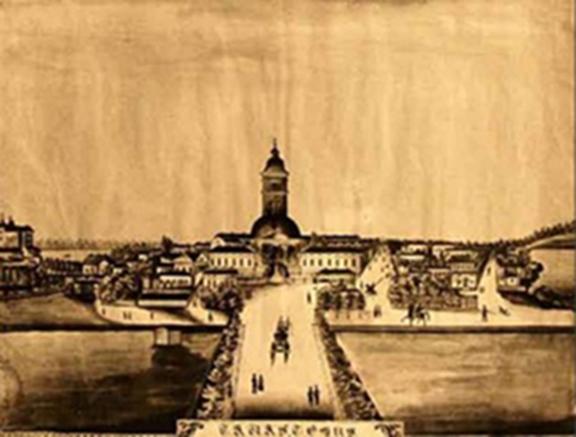
In the early 19th century, the area at the end of Turuntie was called Hevostori (Horse Square). The unambiguous origin of the name was that it was customary to leave horses in this field when entering the city, and horse and animal markets were also held in the square from time to time. The square also once featured a whipping post for the flogging of criminals, but this was moved to a more open location near the castle in 1813. In Engel’s town plan following the 1831 Great Fire of Hämeenlinna, the Hevostori area was named “Lilla Torget” – Pikkutori (Little Square). Until then, the square had only been a field in its natural state. In 1835, however, the horse markets were moved to Poltinaho, and Pikkutori was converted from a grass field into a park area. The square was leveled, fenced, and in the following decade, a total of 80 maple saplings were planted there. Thus, Pikkutori was transformed into a walking park, which it remained until the construction of the Orthodox church.
Viktor Jansson’s Nuoruus statue
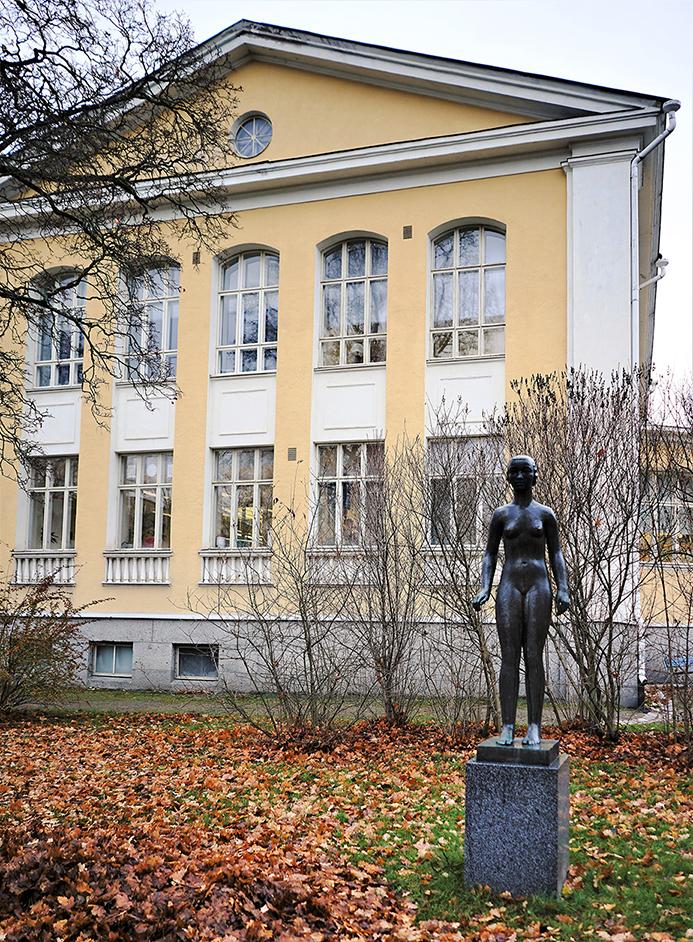
A bronze statue depicting a young woman has stood on the southern side of Kumppanuustalo since 1967. The plaster model of the statue comes from the sculptor’s estate, from which it was given to the City of Hämeenlinna. Kummila Oy had the work cast in bronze and officially donated the sculpture to the city at an unveiling ceremony on June 21, 1967.
“The statue is a variation of Jansson’s Convolvulus theme (Convolvulus is the scientific name for bindweed, or ‘elämänlanka’ in common parlance). From 1929 onwards, Jansson made several sculpture sketches depicting a young woman. Common to these works is a refined, simplified, and decorative expression based on classicism. In these works, the artist’s daughter, Tove Jansson, served as the model.”
The most famous statue of the Convolvulus theme is the work that also bears the name Convolvulus in Kaisaniemi Park in Helsinki.
“Viktor Bernhardt (Faffan) Jansson was born on March 1, 1886, in Helsinki and died on June 22, 1958, in Helsinki. Jansson was a prolific sculptor. He created statues of heroes, portraits, grave monuments, lyrical sculptures, and fountains, often featuring small putto-like boys and mermaids.
Typical of most of Jansson’s outdoor sculptures are lyricism, harmony, solid form, and a clear description of the rhythm of movement. Children and female figures were themes to which Jansson returned constantly. The material was often marble, but Jansson was at his most natural when modeling clay. The best insight into Viktor Jansson as a person can be found in the books ‘Sculptor’s Daughter’ and ‘Moominpappa at Sea’ written by Tove Jansson.”
Sources and images
Lindeqvist, K.O. 1930. History of the City of Hämeenlinna: Part III. City of Hämeenlinna: Hämeenlinna.
Putkonen, Lauri. 2007. A report on the town plan, building history, and urban landscape of Pikkutori, the Finnish barracks, and the old cemetery.