
Zoning
Zoning is land use design aimed at ensuring the development of a good living environment. The municipality is responsible for master planning and detailed planning. The regional plan prepared by the Regional Council guides the planning at the regional level.
Detailed planning
A detailed plan defines the future use of an area: what is preserved, what may be built, where, and how. The plan designates, for example, the location, size, and purpose of buildings.
A detailed plan may cover an entire residential area with housing, employment, and recreational zones, or sometimes only a single plot. The municipality prepares the detailed plan.
A detailed plan includes a plan map, plan notations and regulations. The detailed plan includes a preparation report of the plan and its key features.
The Land Use and Building Act provides the base and detailed guidance on the content requirements of plans concerning appropriateness, health, traffic, amenity, and aesthetics, as well as natural and cultural values. Plans must also be kept up to date.
Master planning
A master plan is a general land use plan covering the entire city center area and parts of the surrounding districts.
The purpose of the master plan is to guide the placement of various community functions, such as housing, services, transport, workplaces, and recreational areas, and to coordinate these functions.
Master planning determines the principles of the desired development, and the master plan guides the preparation of detailed plans for the area.
Shoreline zoning
According to the Land Use and Building Act, construction on shorelines is prohibited without a detailed plan or a master plan intended to guide construction. If no plan exists, a deviation permit is required for construction.
A shoreline detailed plan or a master plan can guide the construction on shoreline areas with the preparation costs falling on the landowner.
Participation in zoning projects
Plans are prepared in discussion with those whose circumstances or interests they affect. These include, for example, landowners in the plan area, residents, and other users of the environment.
The city states current planning projects on its website, in newspapers, in planning reviews, and by letter to landowners in the plan area. Communication about planning ensures that stakeholders have the opportunity to follow and influence the planning.
The participation and assessment plan includes planned events for participation and information about the planning project. You can participate in many ways, for example by contacting the planner, attending information and discussion events, or submitting an opinion on the plan when it is on public display.
Progress of a zoning project
The stages of the planning process: initiation stage, draft stage, proposal stage, and approval stage. Stakeholders have the opportunity to influence at all stages of the planning process.
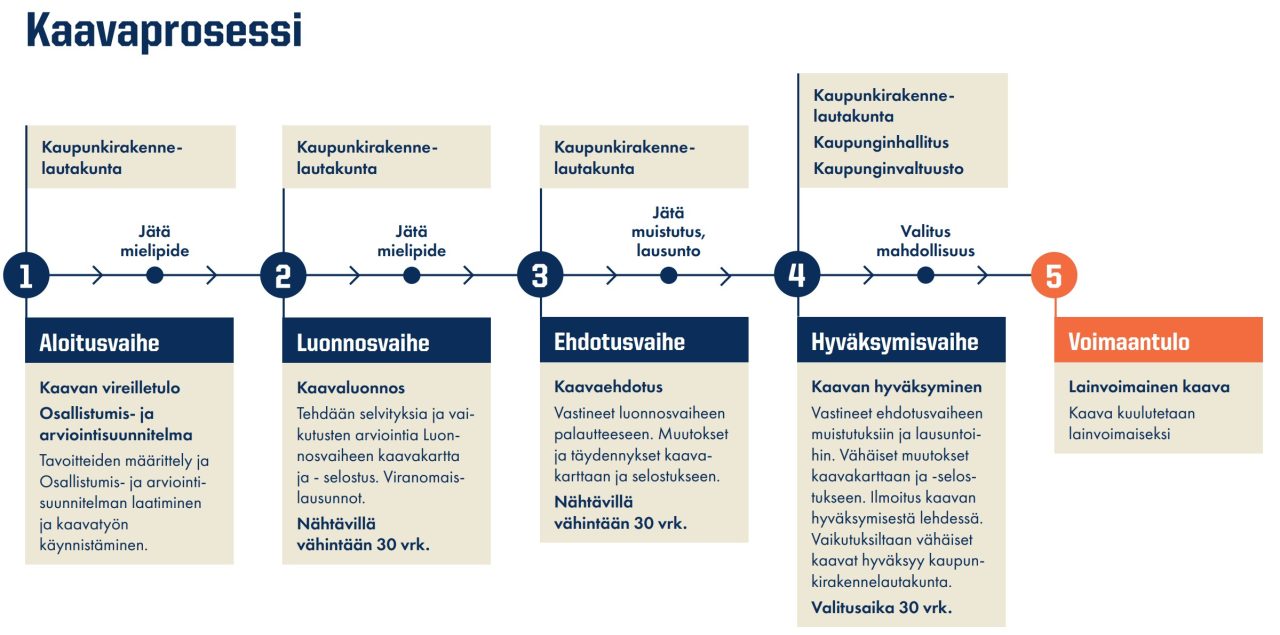
Initiation stage
- The city or a private party can initiate a zoning project to be added to the planning work list. However, the city decides on the initiation of the plan.
- A pending status is notified in the planning review or by separate announcement.
- The participation and assessment plan is announced for public display. In addition, preliminary plans and completed reports may be presented.
- The zoning project gets a website.
Draft stage
- Discussions with stakeholders.
- Reports and assessments of impact.
- Express your opinion on plan draft or drafts during the public display period. In the draft stage, the plan is on display for 30 days, minor plan amendments for 14 days. Public display is announced in the newspaper, on the city’s website, and notices are sent to stakeholders.
- The Urban Environment Committee reviews the plan draft.
Proposal stage
- A plan proposal is prepared based on the selected plan draft.
- The Urban Environment Committee reviews the plan proposal.
- The plan is placed on public display. During the display period, it is possible to submit a comment.
- The proposal-stage plan material is on display for 30 days. Public display is announced in the newspaper, on the city’s website, and notices are sent to stakeholders.
Approval stage
- The City Board or The Urban Environment Committee reviews the plan proposal, comments, and responses.
- The City Council or The Urban Environment Committee approves the plan. An announcement of the plan’s approval is published in the newspaper and on the city’s website.
- Stakeholders have the right to appeal after the decision.
Entry into force
If no appeal is filed against the decision, it becomes legally valid after the appeal period expires. The plan is then announced as coming in force on the city’s website.