
Part 2. Hiisivuori and the gathering places of Hauho
In the previous part of the series, we got to know Sigfrid Antinpoika, who ran into trouble after asking the weather god Ukko for rain. Next, we will explore the places where similar rain rituals may have been performed as far back as a thousand years ago. Our first stop is Hiisivuori.
The illustrations accompanying this article were created using artificial intelligence. Text and AI images: Ossi Nyström
A headland extends into Lake Aulanko that is known as Lusikkaniemi. Previously, however, it was known as Hiitiönniemi. Similarly, Hiidenniemi can be found in Järviö, and in Kalvola there is an area that has been called Hiidenmaa. On the border between Hauho and Tuulos rises a rock formation named Hiisivuori. Similar places can be found throughout Hämeenlinna, and it is possible that they were all once prehistoric sacrificial sites. However, we cannot be certain of this.
This uncertainty stems from the fact that when the Iron Age ended a thousand years ago and the historical period began, the area of present-day Finland was inhabited mainly by people who could neither read nor write. This is why we have no contemporary written sources concerning prehistoric sacred sites. However, we can draw conclusions about the distant past based on, for example, archaeological finds, folk poetry, and place names.
When you look at a map of Finland and zoom in on, say, Hämeenlinna, place names quickly catch your eye that seem as if they were dreamed up by someone’s great-grandmother. This is no wonder, since some of these names are over a thousand years old. Such ancient place names include, for example, those that contain some form of the word ‘hiisi’.
Before the arrival of Christianity, a hiisi referred to a sacred grove of the ancient Finns, where villagers would gather to celebrate annual festivals and to seek help with their problems from the spirits of the deceased or from gods such as Ukko. The needs of Iron Age farming communities were likely very similar to those of the Kokkila villagers who suffered from drought half a millennium later. If Sigfrid Antinpoika knew of his ancestors’ old sacrificial sites, he would have had several nearby options that could have suited his libation-pouring purposes reasonably well.
The fearsome hiisi mountain
At Hiidenkallio, on the border between Sotjala and Tuulos north of Lake Pyhäjärvi, there is said to be an opening leading to the bottomless Hiidenluola cave. Once, on Christmas night, a man rode out of it on a white horse across the unfrozen surface of Lake Pyhäjärvi. When the church bells began to ring, he sank beneath the waves.
Oiva Keskitalo: Catalogue of the Fixed Ancient Monuments of Hauho Parish, 1941 and 1945
The hiisi name closest to Sigfrid’s dwelling place at the time is found on the opposite side of Lake Pyhäjärvi. This rock, which rises steeply from the shore and has been assessed as a locally valuable natural site, is called Hiisivuori, though it has also been known as Hiidenmaa and Hiidenkallio. In front of it lie the Hiilensaaret islands, and the highest point of the mountain is named Hiidenkorkein.
According to legend, a girl who was threshing flax met a gruesome death when a large boulder was hurled down upon her from Hiisivuori. Those left to mourn her were hardly comforted by the knowledge that it had been a sheer accident — the giant who threw the Neittykivi boulder had in fact been aiming for Hauho Church, not the girl. Today, Hiisivuori is no longer a battleground for giants or other trolls, but a summer cottage area for many ordinary people. This should be kept in mind when moving around the area.

On the Border of Worlds.
In addition to serving as a place for boulder-throwing, Hiisivuori is known to have functioned as a boundary point between settlement and common land as far back as prehistoric times. This border character appears in connection with many other hiisi sites as well. It has been suggested that areas named hiisi may originally have been a kind of boundary marker.
It was practical to choose a prominent feature in the landscape as a boundary marker — one whose location could easily be explained to others. A large boulder, for instance, made a good boundary marker partly because no one would be able to move it. It is possible that the people who drew these boundaries also buried the remains of their relatives at such sites as an added precaution, with the underlying idea that respect for the dead would discourage people from challenging the boundary.
It is possible that it was precisely from such boundary groves that the religious sanctuaries of late Iron Age Häme villages — and perhaps even parishes — eventually developed, with village infrastructure, including dwellings, burial grounds, and hillforts, growing up around them. However, not all hiisi sites were burial grounds. Hauho’s Utterinvuori, for example, is an ancient sacrificial grove, though the offerings there were likely not made to a deceased family member.
The Temple of the Tufted Goddess.
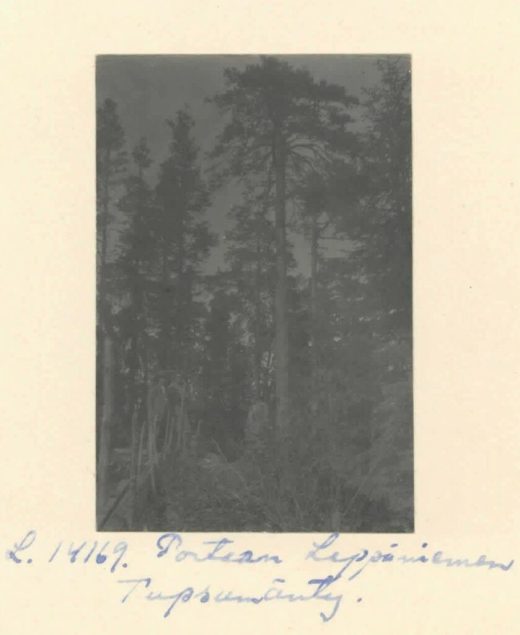
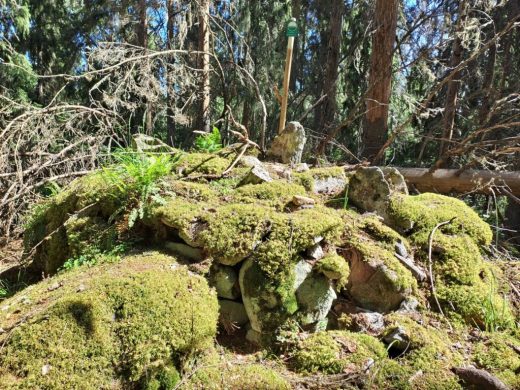
Utterinvuori is a medieval boundary site and is now a protected area of the Finnish Natural Heritage Foundation. In the oldest parts of this uncut old-growth forest grow centuries-old trees reaching toward great heights, trees that in their youth bore witness to things of which humans retain no memory whatsoever. Today, the mountainside is covered in moss-draped stones the size of a sedated bear, with very few paths leading to the summit — but hundreds of years ago, the mountain could have provided an excellent setting for ritual purposes such as Sigfrid Antinpoika’s.
It is said that ancient paths once led to the mountain from various directions, converging as late as the latter half of the 19th century on an open, level field. From this field, a path led to the highest point of the mountain, where there grew an ancient pine known as Tupsumänty, the trunk of which is likely still standing at the summit today.
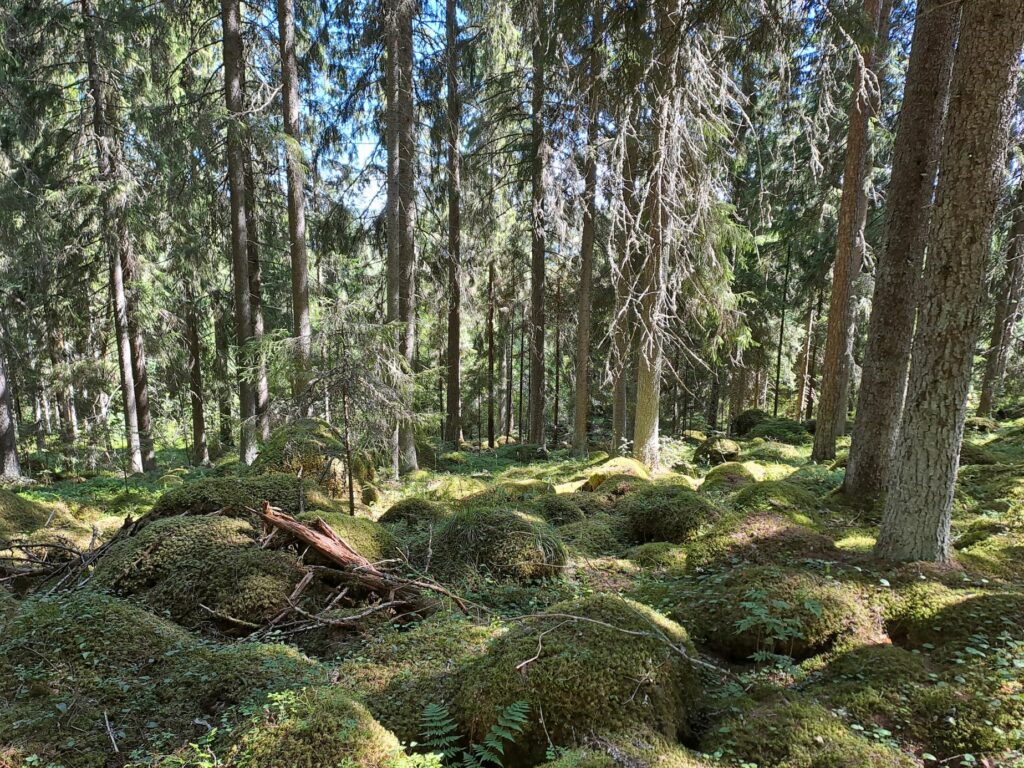
According to an account recorded in the 1880s, people moving away from the area had to strike a piece of iron against the trunk of Tupsumänty before leaving, so that the Tufted Goddess would grant the emigrant good fortune on the journey.

According to another tradition, those who had been lazy with their fieldwork were required to make an offering to Tupsumänty by striking pieces of iron into its trunk. Meanwhile, smaller iron objects such as coins and needles were dropped into the nearby Utterin sacrificial spring, located in a field beside the hill and later enclosed as a well.
The tormenting of field laborers described above can be understood as a fertility rite intended to promote crop growth. This ritual, practiced during the historical period but likely originating in some form even earlier, may have been meant to magically make up for whatever was felt to be lacking in people’s daily labor. However, the most natural link between figures like Sigfrid Antinpoika — who nourished their fields through divine connection — and Utterinvuori is best drawn from the place’s name itself.
A beloved mountain with many names
The name Utterinvuori is believed to date back to the early 19th century, when the Utteri family lived near the mountain. Before that, the mountain was known as Karkiovuori or Arkiovuori. The oldest names for present-day Utterinvuori, however, appear to be Henkivuori and Kenkivuori. ‘Kenkki’ is a word that even Mikael Agricola used to refer to a gift and to the pouring of a drink. Kenkivuori can thus be understood as a place dedicated to the drinking of a sacrificial beverage.
The needs of thirsty Hauho residents and their gods were taken seriously in times past. This is evidenced by the fact that, four kilometers from Utterinvuori toward Kokkila, there is another hill also named Kenkivuori, located along the same 1431 boundary line as Utterinvuori.

Kenkivuori is located a quarter of a Swedish mile from the village of Sotjala and is a gently sloping hill full of rocky knolls, hollows, and underground passages.
C. Herkepaeus: Historical and Economic Description of the Parish of Hauho in 1756.
It would have been considerably easier for Antinpoika’s party to make their way to this other Kenkivuori with their load of nine beer jugs than to Utterinvuori. Yet this Kenkivuori was hardly the site where Sigfrid got into trouble with the law, since neither of the two Kenkivuori hills ever had enough lake water suitable for sprinkling and wading rituals. One and a half kilometers from Utterinvuori toward Kalaila, however, an old boundary site did not lack for water. This boundary site is called Kenkijärvi.
It is unlikely, however, that Kenkijärvi was the exact place where Sigfrid’s party carried out their ritual. According to court records, the party made their way home along a stream, and Kenkijärvi’s waterways never reached as far as Kokkila.
It is more likely that rain was sought on the shore of some lake closer to Kokkila. One such lake could have been the now-drained Hankalanjärvi, from which a stream once flowed toward Kokkila, and beside which lies a large field and forest area called Viritty. From today’s perspective, there is nothing strange or noteworthy about Viritty. Yet for some reason, it gained such a dreadful reputation that, as late as the early 20th century, it was considered the most feared place in all of Hauho.
Old Tarri, returning from town, was once made to dance in Viritty until the soles of his new bast shoes wore right through.
Oiva Keskitalo: Catalogue of the Fixed Ancient Monuments of Hauho Parish, 1941 and 1945
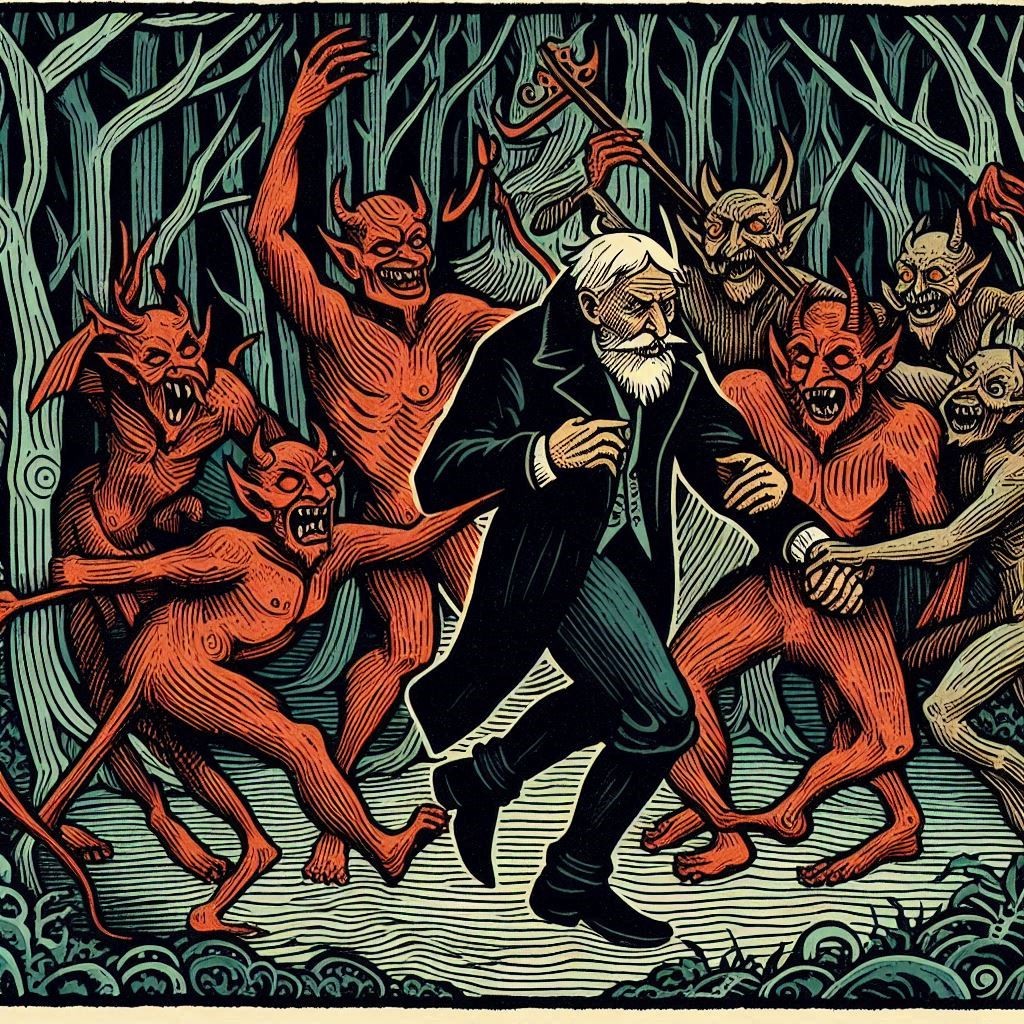
Christopher Herkepaeus, who described conditions in Hauho parish in the mid-18th century in his dissertation, notes in the section on sacrificial springs that terrifying apparitions always appeared during sacrificial events, frightening those making the offerings. Who knows — perhaps even the ghosts of Viritty were originally drawn to the area by some such sacrificial event, and simply stayed on.
A Sacrificial Site, or the Home of Giants?
The word ‘hiisi’ appearing in a place name may be linked not to the site’s character as a sacrificial place, but to later folk tales about giants.
With the arrival of Christianity, the word ‘hiisi’ became demonized to mean hell, or a malevolent supernatural being, while its original meaning as a sacred grove was forgotten. Natural features such as mountains and rocky forest hills came to be seen in people’s minds as the dwelling places of devils, trolls, and hiisi-giants, who were thought to have shaped the landscape by moving great stones.
For example, Aulanko’s Hiitiönniemi may have gotten its name either because it was a sacrificial site, or because the rock formations on the headland were thought to be the work of hiisi-giants. Giant legends may later have become attached to natural sites already known as sacrificial places, but not all hiisi sites associated with giants were necessarily ever sacrificial sites.
Sources
Anttonen, Veikko: Uskontotieteen maastot ja kartat (2010).
Herkepaeus, Christopher: Historiallinen ja taloudellinen kuvaus Hauhon pitäjästä vuonna 1756 (1956).
Keskitalo, Oiva: Luettelo Hauhon pitäjän kiinteistä muinaisjäännöksistä 1941 ja 1945 (1945).
Keskitalo, Oiva: Esihistoria, teoksessa Koskimies, Y.S.(toim.) Hauhon, Luopioisten ja Tuuloksen historia (1985).
Koski, Mauno: Itämerensuomalaisten kielten hiisi-sanue (1968).
Place Names and Local Legends 1879-1882: Karkiovuori [PLACE NAMES AND LOCAL LEGENDS 1879-1882 (kotus.fi)]
Pulkkinen, Risto: Suomalainen kansanusko – Samaaneista saunatonttuihin (2014).
Rapola, Martti: Suomalaisia näköaloja (1956).
Suvanto, Seppo: Keskiaika, teoksessa Koskimies, Y.S.(toim.) Hauhon, Luopioisten ja Tuuloksen historia (1985).
Digital Name Archive:
Hölli, Leena: Henkivuori, Hauho (Kotus, 1970) [Henkivuori (Kotus, 1970) – Name Archive]
Hölli, Leena: Tupsumänty, Hauho (Kotus, 1970) [Tupsumänty (Kotus, 1970) – Name Archive]
Hölli, Leena: Utterinvuori, Hauho (Kotus, 1970) [Utterinvuori (Kotus, 1970) – Name Archive]