
Part 4. The many faces of the thunder god
In the previous part of the series, we made our way along the Hattelmala ridge road and peered into other realities. We continue along the same road, and along it we find peculiar and ambiguous places. Eventually we arrive in Janakkala, where we drop a coin into the Taara Spring.
The illustrations in this article were created using artificial intelligence. Text and AI images: Ossi Nyström
When trying to determine the ancient “purposes” of natural sites based on place names, one may, at worst, be swept into an etymological whirlwind, where the tangle of strange folk tales and imaginative word explanations can yield endless interpretations for place names that have lost their original meaning.
For example, the Hattelmalanharju ridge area is full of places that, going by their names, could have served as all kinds of sites of worship. Tyyriönmäki, Panu’s plot, and Rauninmaa, among others, can be interpreted as prehistoric places of worship connected to Ukko — and indeed, they have been.
Hattelmala was sheltered from the north by a high ridge, making it an excellent village site, and to guard against the northwesterly winds blowing along the edge of the ridge, people are said to have worshipped Tyyri, or Ukko, and Rauni on the hills on that side of the village. Panu’s plot may possibly refer to the same kind of worship.
Seppo Suvanto: Vanaja's Middle Ages, in the work The History of Vanaja I
Connecting these names to ancient Finnish religious practice is reasonable in itself, but more mundane and simpler explanations can also be found for them. For example, the name Panu has indeed been linked in folk poetry to thunder, lightning, and seers, but Panu’s plot could just as easily have been simply the plot of someone named Panu.
In the same way that Panu may have been just Panu, Rauni too may have been just Rauni. On the other hand, Rauninmaa may also have referred to a somewhat obscure figure in ancient Finnish mythology, interpreted as either Ukko’s wife or Ukko himself.
Unrestrained hiisi revelry
Rauni appears in Mikael Agricola’s list of pagan gods, compiled in the mid-16th century. In his list, written in verse, Agricola mentions, alongside various deities, the Ukko basket festival, which was said to be celebrated at hiisi sites in connection with the spring sowing. The programme of the Ukko basket festival included, among other things, the drinking of Ukko’s toast, which Sigfrid Antinpoika later carried out in Hauho, detached from its original basket-festival context. The original Ukko basket festival, however, involved much more besides:
And when the spring sowing was sown
then Ukko’s toast was drunk.
Thither was fetched Ukko’s basket
so that both maid and wife grew drunk.
Then much shame was there wrought
both heard and seen alike.
As Rauni, Ukko’s wife, did rage
nobly did Ukko from the north rush forth.
So he gave both weather and new harvest.
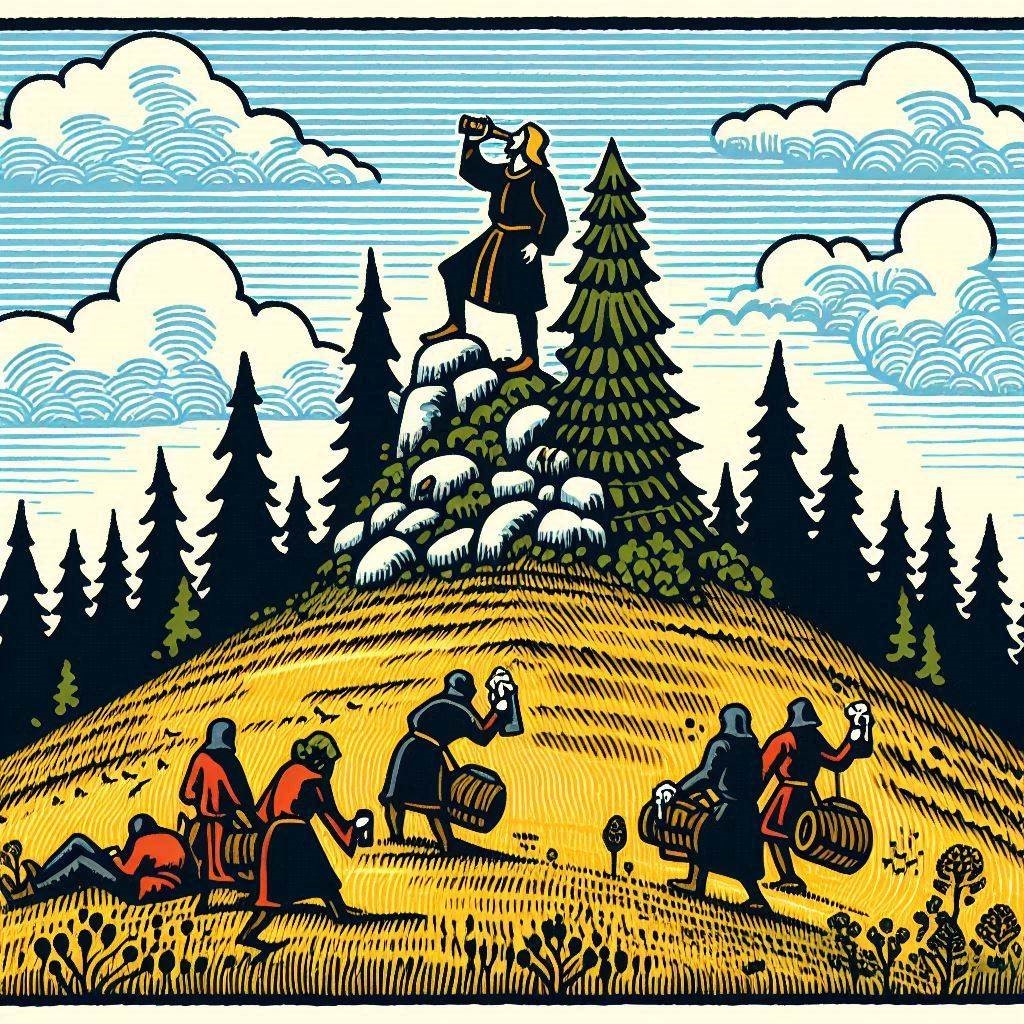
The most striking interpretation put forward regarding Agricola’s basket-festival account is that the drunken celebrants engaged in ritual group sex in the hiisi groves. It has been suggested that the purpose of such a ritual was to set an example, so to speak, for Ukko and Rauni, whose lovemaking was hoped to bring about rain and the growth it would bring to nearby fields.
Rituals of the kind described above are not unheard of elsewhere in the world, and it is entirely possible that similar ones were carried out here as well. However, Agricola’s poetic account can also be interpreted in many other ways. It is also worth treating with some caution, firstly, what Agricola actually knew about the basket festivals, and secondly, what the reformer Agricola intended to achieve with his account. It would not have been the first time that the “perniciousness of pagan customs” was emphasised with a bit of artistic license.
Mill Owner or God of Thunder?
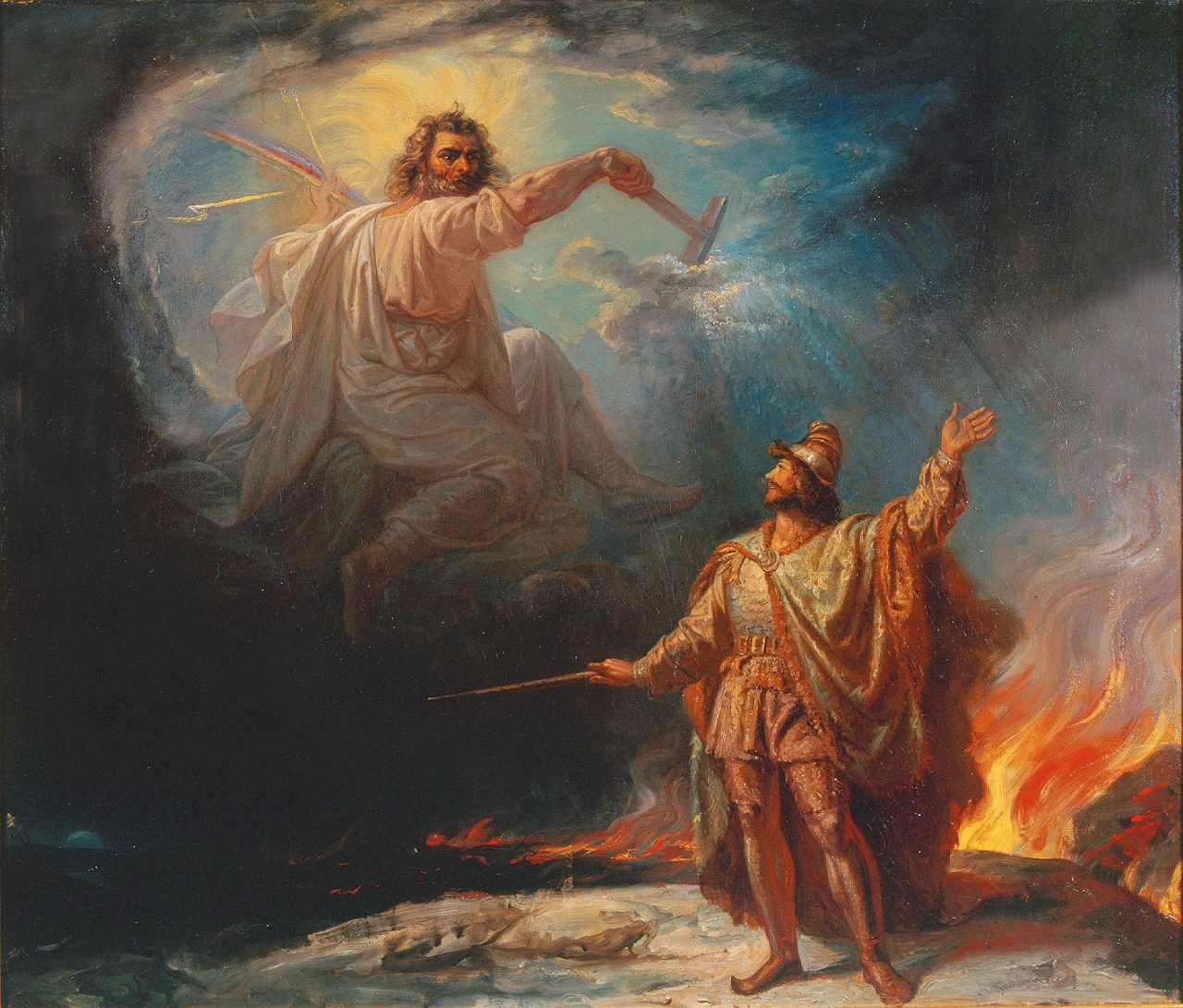
No places that could be directly linked to the Ukko basket festivals, for example on the basis of oral tradition, are known from the present-day Hämeenlinna area. However, there are places here that are connected to Ukko in one way or another, at least by name. One such place may be Tyyriönmäki, located in Hattelmala.
At first glance, however, the name Tyyriönmäki might seem connected to the Tyrynoja stream flowing from Lake Hattelmalanjärvi, which took its name from the Tyrynmylly mill situated along it. The mill, in turn, was named after its owner, a man called Tyry.
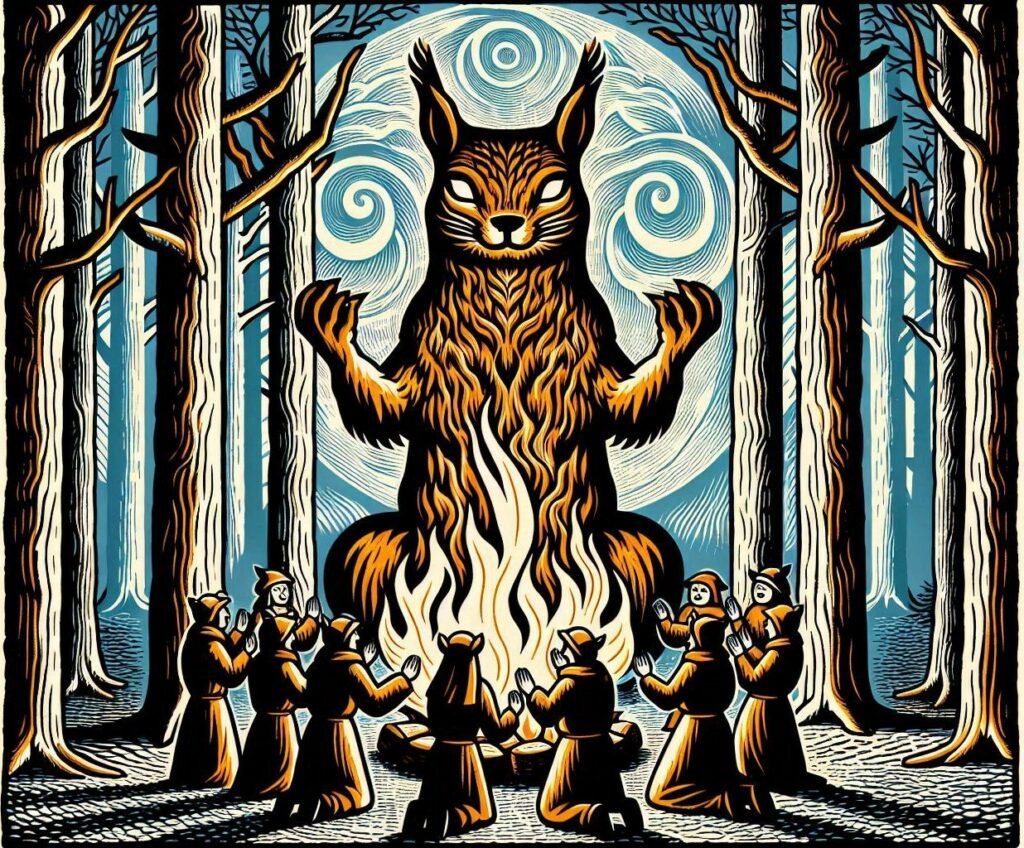
Another explanation can be found in ancient incantations. In them, the name Tyyri appears in connection with squirrels. This is because the species-guardian of squirrels — a kind of ancestral mother figure — was called Tyyriki. Tyyriönmäki could therefore be a place where squirrels once scurried about in great numbers. Or a place where people, for some reason, saw fit to worship the ancestral mother of squirrels.
Now, since we would like to conjure up Ukko, the High God, from the place names of Hattelmala, we must assume that Tyyriönmäki was named not after squirrels or a mill owner, but after the ancient Scandinavian god of thunder, Tyr.
The names Tyyri and Tuuri, derived from the name Tyr, have at times also been used when referring to Ukko. The idea behind this was that, just as the bear was respected and feared so greatly that people did not dare speak its true name aloud, various circumlocutions were also devised for Ukko. In fact, even the name Ukko may itself have been merely a euphemism invented for this particular god. Other similar designations included at least Äijä, Isänen, and Palvanen, from which it is easy to draw a connection to Palvaanlinna, located in Miemala.
A worshipped site, or a fortress of smokers?
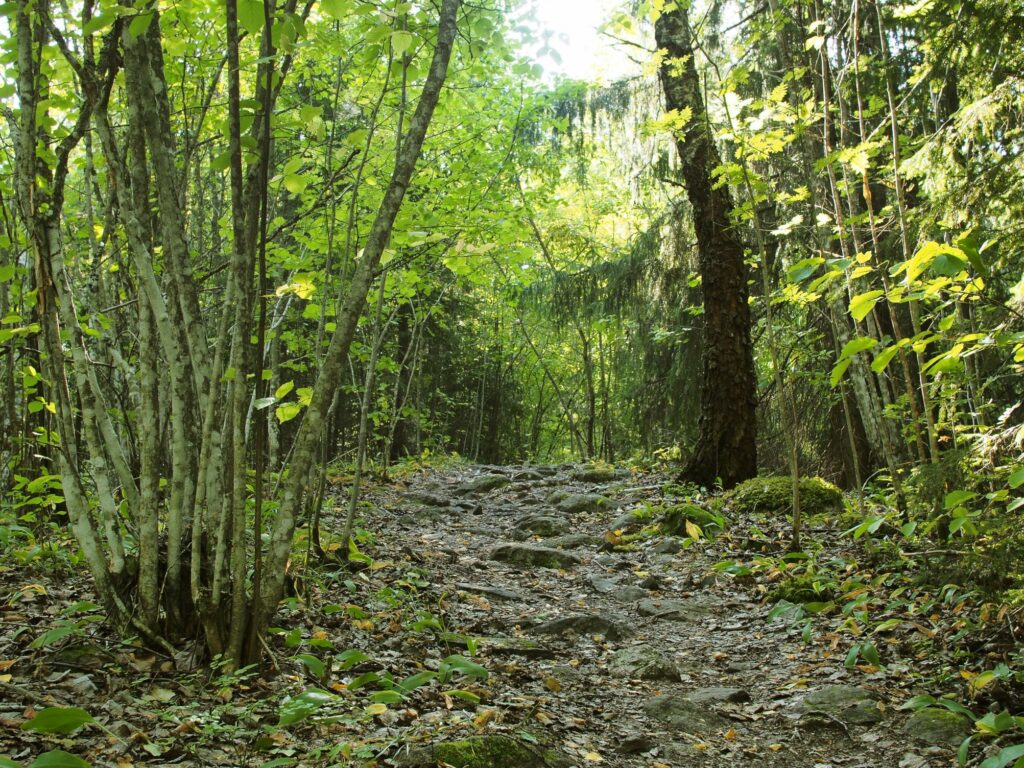
According to oral tradition, the name Palvaanlinna was originally Palavalinna, said to derive from signal fires once lit on top of the hill. Another story holds that the name Palvaanlinna comes from the fact that the site was a place of worship (“palveltu paikka”). A third story suggests that Palvaanlinna refers to a fortress once on top of the hill, whose lord the people are said to have worshipped. According to a fourth explanation, the name Palvaanlinna derives from the smoking of meat (“palvaaminen”) once practised on the hill.
It would be tempting to accept that the word referring to meat-smoking really does relate to that practice, rather than, say, to some worshipped lord of the fortress whom no one has ever heard of. But Palvaanlinna was indeed some kind of place of worship after all! This is evidenced by the fact that at the foot of the cliff there once stood a sacrificial stone known as Matokivi — later moved and broken — as well as a sacred spring. According to oral tradition, offerings were made at the Matokivi spring to its guardian spirit, for example by giving it gifts such as coins and needles.
Something is happening at the Taara Spring!
From the records of a court session held in the village of Turenki, in the parish of Janakkala, on the 7th of last March, the Consistory notes with displeasure that, among other things, people from your honourable parishes are said still to gather each year at the Janakkala churchyard hill on Lauri’s Sunday, where many bring beer and spirits to sell, and where one person or another drinks strong liquor to excess, which then leads to fighting, cursing, and the like. Some also engage in all manner of sorcery, rubbing themselves at the spring located near the churchyard.
Turku Cathedral Chapter, 1731
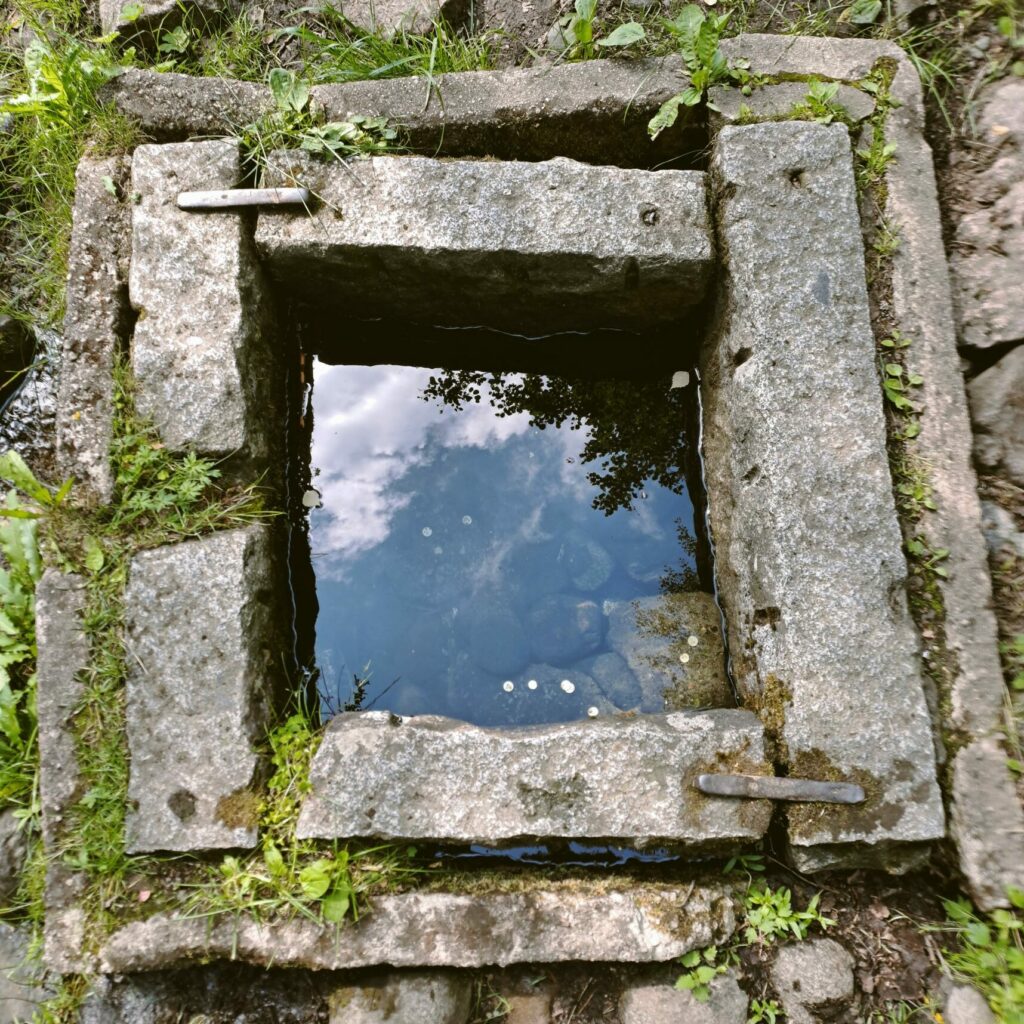
No detailed oral tradition survives concerning the guardian spirit of the Matokivi spring, but it is possible that Ukko himself served as the guardian of some springs. This can be inferred, for example, from the fact that the sacrificial spring known as Elämänlähde, located in Lammi, has also been called Ukonlähde. A well-known example of a spring named after an ancient god is found in Tarinmaa in Janakkala, where the Laurinlähde spring, situated in a sacred grove, is believed to have been dedicated, before the Catholic era, to the Estonian god Tarapita, under the name Taara Spring.
There are two different accounts of the location of Ukonlähde in Lammi. According to one, the spring lies at the foot of Onnenvuori, and according to the other, at the foot of Linnamäki. For the purposes of the subject at hand, however, the most relevant point is that, between these two sites, on the shore of Lake Lovonjärvi, lies a place called Hiidenhoilo, associated with healers and witches. That is where we shall travel in the next part of the series, mercifully setting aside the inconvenient fact that the name Ukonlähde alone cannot actually tell us whether the spring was named after the god of thunder or after some old man (“ukko”) who once lived nearby.
What was worshipped at the hiisi sites?
Linguist Mauno Koski, who mapped hiisi sites for his doctoral dissertation, found in his research that Finland’s hiisi sites form two larger clusters. The first is located in the Southwest Finland and Satakunta region, extending into the southwestern parts of Häme and Uusimaa. The second cluster is located in the broader Savo-Karelia region.
Scholar of religion Risto Pulkkinen has suggested that, in the late Iron Age (c. 800–c. 1200), the hiisi sites of the western cluster developed, through agricultural culture and the associated cult of the dead, into burial hiisi sites, where the community’s notable deceased were asked for good fortune in livelihood — chiefly a good harvest. Hiisi sites established before the agricultural era are thought to have been places where people turned to various gods, for example in hope of good fortune in hunting.
The boundary between these hiisi cultures is very blurred. It is likely, for example, that in the western burial hiisi sites, people relied not only on the spirits of the dead but also on the help of the gods. Here, the dead may have been thought to act as a kind of messenger. Indeed, Martti Haavio has compared the drinking of Ukko’s toast to a tradition known in Scandinavia, in which a toast was drunk in order to establish a sacred connection involving not only the gods but also the deceased members of the family.
Sources
Haavio, Martti: Suomalainen mytologia (1967)
Kerkkonen, Veikko: Janakkalan historia (1931)
Koski, Mauno: Itämerensuomalaisten kielten hiisi-sanue – Semanttinen tutkimus I (1967)
Nissilä, Viljo: Suurvanajan nimistöä, in Koskimies et al. (eds.) Vanajan historia I (1976)
Pulkkinen, Risto: Suomalainen kansanusko – Samaaneista saunatonttuihin (2014)
Puolamäki, Laura; Koski, Katriina: Perinnemaisemat Kanta-Hämeessä -esiselvitys (2022)
Salo, Unto: Ukko: The God of Thunder of the Ancient Finns and His Indo-European Family (2006)
Suvanto, Seppo: Vanajan keskiaika, in Koskimies et al. (eds.) Vanajan historia I (1976)
Tarkiainen, W.: Mikael Agricolan runot ja virret (1929)
Uljas, Kiuru: Lammi – Kuvia ja kertomuksia pellavapitäjästä (1989)
Digital Place-Name Archive:
Koivuniemi, Lea: Matokivi, Vanaja (Kotus, 1963) [Matokivi (Kotus, 1963) – Name Archive]
Koivuniemi, Lea: Palvaanlinna, Vanaja (Kotus, 1962) [Palvaanlinna (Kotus, 1962) – Name Archive]
Kuusela, Riitta: Tyrynoja (Kotus, 1971) [Tyrynoja (Kotus, 1971) – Name Archive]